

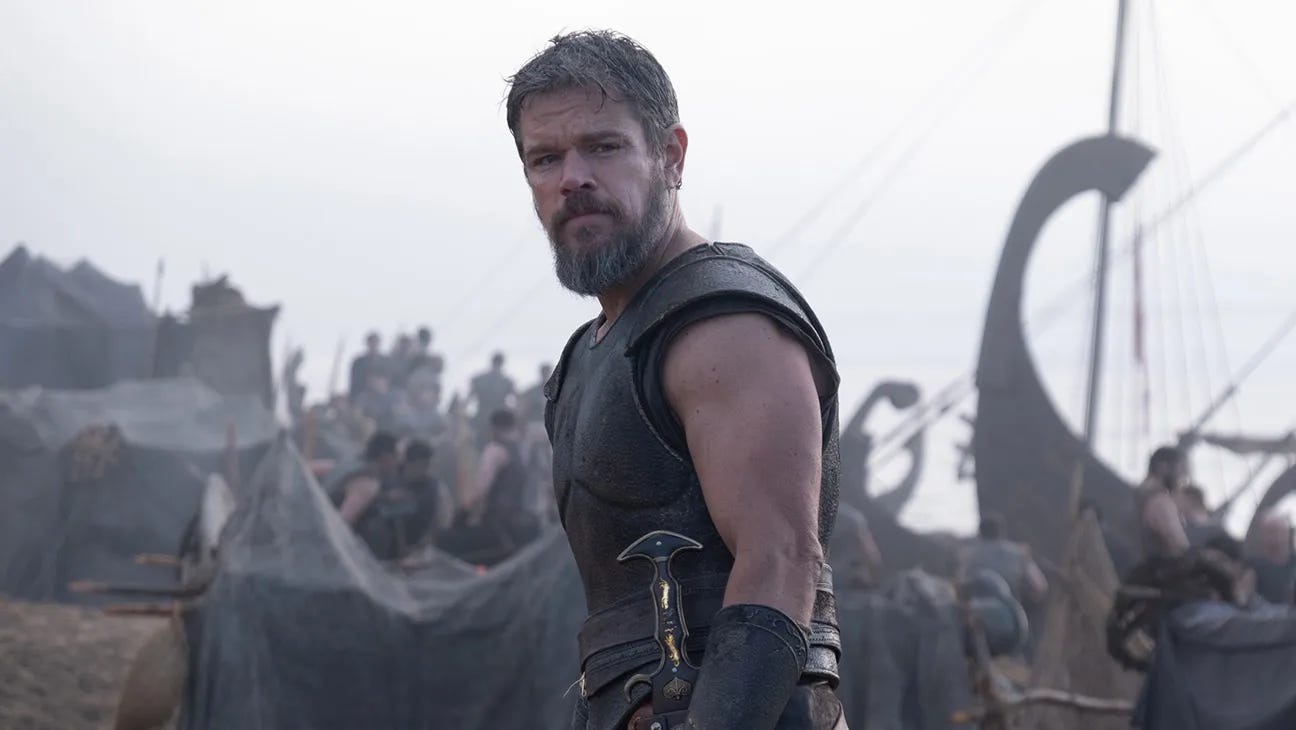
We have been on quite a journey. At first, we buzzed with excitement about the news as we felt we were being called on a great adventure out of the cynical wasteland of deconstruction and anti-heroes and back into the land of heroes. But over time anxiety replaced our excitement. Temperatures rose with each casting announcement, rumors regarding translations, and finally the releasing of that first first trailer. In return, people of the opposite persuasion matched their anxieties. Frustration, worry, and agitation have been the defining characteristics of the conversation swirling around the arrival of Christopher Nolan’s The Odyssey upon our shores. Throughout, I was counted among the anxious, because the adaptation of beloved literature always makes me nervous and because I’ve grown used to our entertainment sneering at the good and noble.
But Nolan, a filmmaker who I am torn on, has steered his Odyssey between the Charybdis and Scylla of the ridiculously polarized discourse and delivered to us through this ancient tale another big-time summer blockbuster that, though flawed, communicates to us eternal truths, even as it addresses more modern themes.
While a good number of sceptics appear either surprised or relieved in their reviews of the film, there are others who were pushed further into their negativity and emboldened in their cynicism. The Economist’s review states that “The simplistic, visual modern world has taken Homer and turned him into social-media spats and an absurd Cyclops - and thus into a tragedy that is all its own.” Others have proclaimed it to be worse than expected, another reason for despair and an “eye-glazing dud”, and too modern - this according to Emily Wilson, the translator of the supposedly “woke” Odyssey. The common thread through the majority of criticism is that what we get on screen isn’t Homer.
But Nolan never attempts to give us a historically exact account, a la Robert Eggers, or a minutely faithful adaptation of what we read in our Fagles, or Lattimore, or Wilson translation. If this isn’t clear from the things that Nolan leaves out (the perilous reality of adapting the written word to film is that things always get left out - you just have to pay attention to what is left on the cutting floor) then the second closing title card at the film’s end clearly spells out the director’s intentions. “Based on Homer’s The Odyssey” reveals to us that Nolan was never trying to be Homer, recreate his epic, or step into his masterful shoes. Despite the title and the rendezvouses with Polyphemus, Circe, Calypso, the suitors, and the rest of the familiar characters, this is not The Odyssey, but the story of Odysseus as told by Christopher Nolan, for us.
In doing so, Nolan hasn’t slipped into relativism or deconstruction, but has stepped into the long tradition of Western storytelling. We have always reevaluated Our stories, characters, and our understanding of them, while still remaining faithful to the primary source; and one needs to look no further than The Odyssey to see this. The Odysseus of Sophocles and Euripides differs from Homer’s. Virgil casts him as the deceitful and fraudulent villain in The Aeneid. Dante, guided by the same Roman poet, finds Odysseus in the bowels of the eighth circle of hell. Time, place, and people shape our different understandings of the same story, and we must understand that this applies to original text too. How many hundreds upon thousands of times was this song performed before it was written down? What transformed over the course of these performances? How did the poet(s) reshape the characters and themes as time passed?
For all of its greatness, The Odyssey did not descend from the heavens. This foundational text of Western literature has been understood and interpreted differently throughout the development of the West by the Romans, Medieval Christendom, and the Victorians, to name a few. Nolan not only enters into this tradition, but gleans heavily from its breadths.1 For Nolan to use the Odysseus story as a way to explore the destruction our sin causes, guilt and shame, the specter of looming civilizational collapse, and the longing for love and restoration, is not an example of moderns scoffing at the ancients. Instead, it is an act of participatory imagination; an act that is in keeping with our tradition of grand and epic storytelling. In its remarkable and necessary “original” form, The Odyssey acts as a mirror by which we compare our biases, desires, and goals against those of a world gone by. Nolan’s work is a lens that allows us to see our world with different sight, or a prism that relieves our eyes from the constant strain of seeking hope and home.
Impressively Nolan’s film, while full of modern concerns and regrettably modern language, retains values and themes that many would consider antiquated. A strong sense of justice, the return of the father, the need for a son to receive his calling to greater things by his father, the virtuous devotion of a wife, and the possibility of forgiveness and renewal in the face of personal and civilizational failure are throughout this story. The only question is, what kind of story is it?
Even after a thousand years, the central question that surrounds the Beowulf poem is “what is it?” Is it a work of Christian imagination penned by an anonymous monk, or a baptized pre-Christian story brought into its fullness? Without being flippant, over time I have begun to think that this question doesn’t really matter because these two positions are not in as much opposition to each other as you may think. It being a story concocted in a monastery does not make it any more powerful and the claim of pre-Christian origins does not delegitimize its Christianization because both quietly claim to us that all truth, all goodness, all virtue, all nobility, and all story come into clarity, fullness, and beauty when it meets the Divine Logos.
Wittingly or not, Christopher Nolan has crafted the story of the Christian Odysseus. The Odysseus portrayed on screen by Matt Damon bears stronger similarities to a chivalric knight of Christendom that he does to the warriors of Ancient Antiquity. There is no striving for Homeric kleos, only the search for redemption. Gone are the willful infidelities of Odysseus that were common among Greek men and instead we him engaging with Circe in chastity and measured justice and fleeing the whiles of Calypso once his memory is restored. While he remains proud and daring, it is less hubristic than in Homer and his greatest act of cunning fills him not with pride, but with shame - a shame covered ultimately covered in the return home, the return to love.
The battles this Odysseus faces are certainly modern, but not stupid or insignificant. The battle against sin and the shame it brings is one we’ve always faced, but now our mistakes can be widely broadcast in a millisecond without hope for escape? We have always been tempted to use our gifts for ill, but now it takes only the effort of pushing a couple of buttons and not that of building a giant wooden horse. We’re all looking for some sort of home, and there are many offers of home, but we keep finding them to be empty. All of us want healing, but drugs and prescriptions and therapy keep us in their loop. We seek rest for our wandering spirits, but are told that only comes after working day and night until the twilight of life. These are old problems, but with new faces. Thankfully the answer remains as constant and sure as ever. In coming home Odysseus finds comfort, love, and forgiveness. When we come home we find the same, and home is always ultimately in our Lord Jesus Christ.
It would be too generous to say this is what Nolan is meaning to communicate with his film. But that is the tricky thing about Truth. Its universality permeates through all little truths spoken. Its power overwhelms our hermeneutics of suspicion. Its loveliness captures hearts unaware. The Truth breaks in whether it is wanted or not and the One who is before all things brings all the glimmers of truth into Himself and holds them all together.
Whether he realizes it or not, Christopher Nolan’s The Odyssey, with its themes and strong moral center, brings the truths of Homer’s great epic closer to its original Source. In giving us a more selfless Odysseus plagued by sin and seeking restoration, only to obtain the hope of finding it, he gives us a story that points us to the greater hope of finding these things in full.
The Odyssey is definitely a flawed movie (dialogue, some performances), but it might just be a masterpiece.
Only time will tell.
Sinon does not appear in Homer, but in Virgil, Dante, and Shakespeare; the film owes its ending to Alfred Lord Tennyson’s Ulysses.